
You are on your couch on a rainy Saturday night. Your friends are scattered across three cities. And yet, in twenty minutes, you will be exploring an abandoned laboratory together, decoding an encrypted message, and trying to unlock a virtual door before the countdown ends. Online escape games have turned this scenario into a reality accessible to everyone, without room reservations or travel.
Native online escape game: why the screen format changes the puzzles
Most people imagine an online escape game as a degraded version of a physical room. A PDF with locks, a somewhat shaky video call. This model exists, but it is fading in favor of creations designed from the start for the screen.
Since 2023, several independent studios have been designing “natively digital” scenarios. This means point-and-click interfaces, puzzles that leverage real-time web elements, and sometimes the integration of live video streams. The French platform Skryptic Online Games, for example, announced in 2024 that its exclusively online experiences represent a growing share of its sales, both for individuals and for team building.
Why does this distinction matter? Because an escape game designed for the browser can offer mechanics impossible in a physical room: modifying a fictional website to find a clue, sending a fake email to a character, manipulating an interactive map. The screen becomes a playground, not a constraint. To explore this type of immersive experiences playable remotely, a useful resource: https://mindtrap.fr/.

Choosing an online escape game: the criteria that make a difference
With the growing offer, how can you distinguish a captivating adventure from a simple disguised quiz? Three criteria deserve your attention before gathering your team.
The mode of communication between players
Some games integrate a voice or text chat directly into the platform. Others allow you to use your own tool (Discord, WhatsApp, classic video call). The first case favors immersion, as the interface remains unified. The second offers more flexibility if your teammates are not comfortable with a new tool.
The duration and pace of the puzzles
A good online escape game generally lasts between forty-five minutes and an hour and a half. Beyond that, fatigue in front of the screen reduces enjoyment. Favor a scenario with a clear narrative thread rather than a succession of unrelated puzzles. The feeling of progressing in a story maintains attention much better than a simple sequence of brainteasers.
The size of the group
The majority of online formats work with between two and six players. Beyond that, some participants become spectators, which breaks the collaborative dynamic. Four players often represent the most balanced format for everyone to actively contribute to solving the puzzles.
- Check if the game offers a system of progressive hints (rather than a blunt solution) to avoid frustrating blockages.
- Look at whether the scenario works simultaneously (everyone sees the same screen) or asymmetrically (each player has different information to share).
- Test the technical compatibility before the big day: some games require a recent browser or a specific extension.
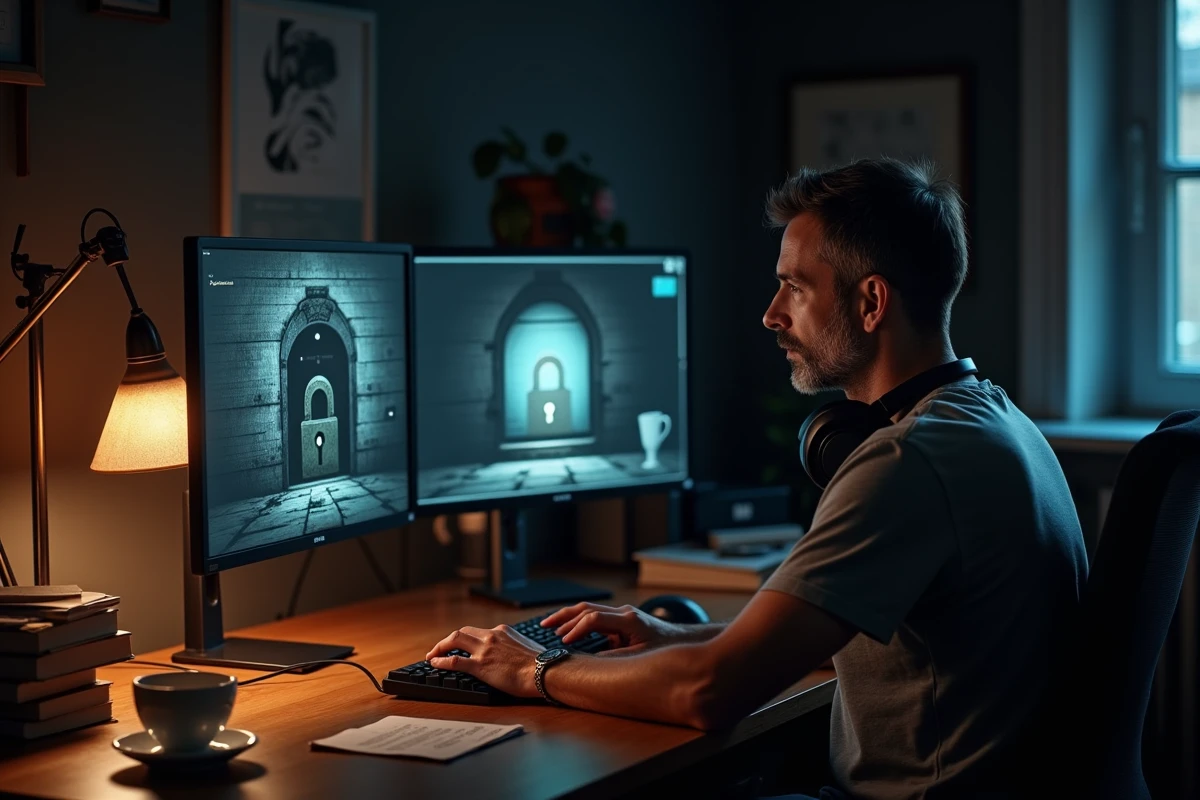
Online escape game for team building: a disguised training tool
The professional use of online escape games has gained notable momentum in recent years. Several training actors have integrated these formats to raise employee awareness on topics such as cybersecurity, GDPR, or CSR. The principle: learning by solving puzzles rather than following a passive e-learning module.
The Club of Information and Digital Security Experts (CESIN) highlights these devices as more effective than traditional training for reducing risky behaviors. The idea is not to replace a complete training but to create a moment of collective engagement around a topic often perceived as tedious.
For companies, the online format presents an obvious logistical advantage: no room to book or travel to organize. A team spread across multiple sites can play together at the same time. The scenario serves as a pretext to observe communication, role distribution, and stress management under time constraints.
Building your own remote escape game night
You don’t need to wait for a special occasion to organize a session. A few choices in advance are enough to transform an ordinary evening into a memorable adventure.
Start by setting the number of participants and the desired level of difficulty. If it’s a first experience for the group, a scenario rated “beginner” or “accessible” will avoid the frustration of the first ten minutes spent figuring out how to interact with the interface.
Plan a five-minute briefing before the launch. Ensure that everyone has access to the link, that the microphone works, and that the browser is compatible. These technical details, sorted out in advance, protect the rhythm of the experience once the timer starts.
- Designate a “team leader” who centralizes information and notes the clues already used.
- Turn off your phone notifications and close unnecessary tabs to stay focused on the scenario.
- After the game, take ten minutes to debrief together: what moments were the most tense, who found the decisive clue, which puzzle blocked the group.
This informal debriefing is an integral part of the fun. The online escape game creates shared memories, even when players are each at home. The next time someone asks, “What are we doing tonight?”, you will have a ready answer.