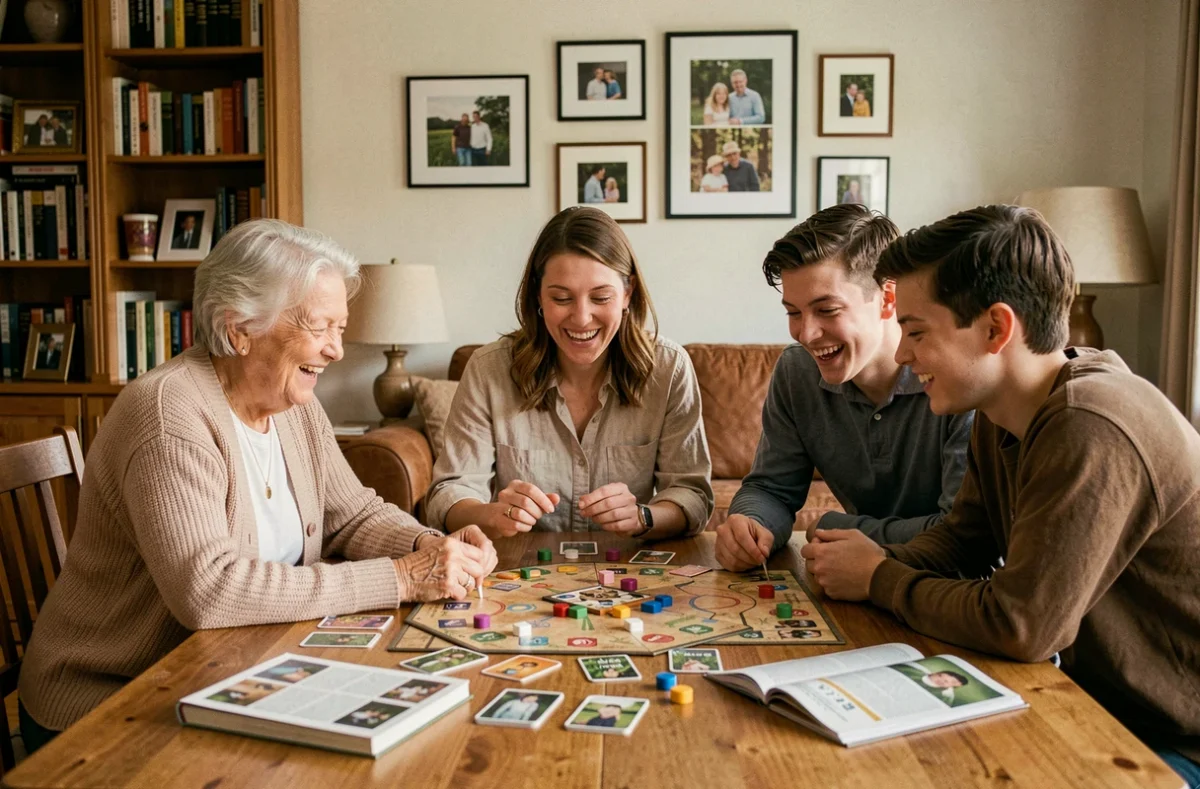
An intergenerational board game brings together at least two different age groups—children, adults, and seniors—around the same game. What sets this kind of gathering apart from simple entertainment is the challenge it presents: each participant has to take into account the abilities, pace, and understanding of the others. In Sète, an association and a games library host game nights every Tuesday, and participants describe these get-togethers as a practical way to combat isolation.
Adapting board game rules for differences in age and ability
Bringing a six-year-old, a parent, and a grandparent together around the same table presents a practical challenge: standard game rules almost always favor one type of player. Adapting the rules doesn’t mean making the game easier; it means leveling the playing field so that every participant stays active and engaged.
There are several ways to do this without changing the nature of the game:
- Reduce the number of cards in hand or pieces to manage for younger players, while keeping the same game objectives for everyone.
- Assign complementary rather than identical roles: a child can be in charge of rolling the dice or sorting the cards, while a senior focuses on long-term strategy.
- Give players more or less time for their turn, without using a rigid timer, to respect everyone’s pace of thought.
At an event organized in Gausson by a library and a seniors’ club, the Loudéac games library brought board games, logic games, card games, wooden games, and construction games. Residents of nursing homes took part. The variety of games meant everyone could find a format suited to their motor and cognitive abilities.
For ideas and advice on different types of games suited to these family settings, https://laminutedejeu.com/ offers a wide range of game mechanics and audiences.

Cooperative family games: succeed together instead of winning alone
A competition between a seven-year-old and an experienced adult rarely makes for a memorable game for both. Cooperative games remove this imbalance by giving all players a shared goal.
The principle is simple: the game itself becomes the opponent. Each player contributes what they do best. A child spots visual details more quickly, a teenager calculates the odds, and a grandparent anticipates the consequences several turns ahead.
In Aveyron, a community worker specializing in board games explains that these mechanics encourage mutual support and help pool skills rather than pit them against one another. This approach changes the dynamic around the table: a collective failure leads to shared laughter, not individual frustration.
When cooperation doesn’t work as well
A poorly balanced cooperative game can have the opposite effect: one dominant player makes all the decisions while everyone else follows along. To avoid this, choose games where information is distributed among players (each player holds cards or clues the others can’t see). This encourages genuine discussion across generations.
Family memories and board games: what makes a moment stick
An ordinary dinner is easily forgotten. A game where a grandparent bluffed everyone with the last card can stay in family conversations for years. The difference comes down to three specific elements.
The first is shared narrative tension: a game creates a dramatic arc (beginning, rising tension, and resolution) that everyone experiences at the same time. The second is physical interaction: handling tokens, rolling dice, and drawing cards engages the body, not just the mind. The third is surprise: unlike a movie watched together, the outcome of a game is unpredictable.
Together, these three factors explain why board game sessions create more lasting memories than other shared activities. The game’s physical components—the box, board, and pieces—become keepsakes in their own right, associated with a place and the people who were there.
Making intergenerational game nights a regular thing
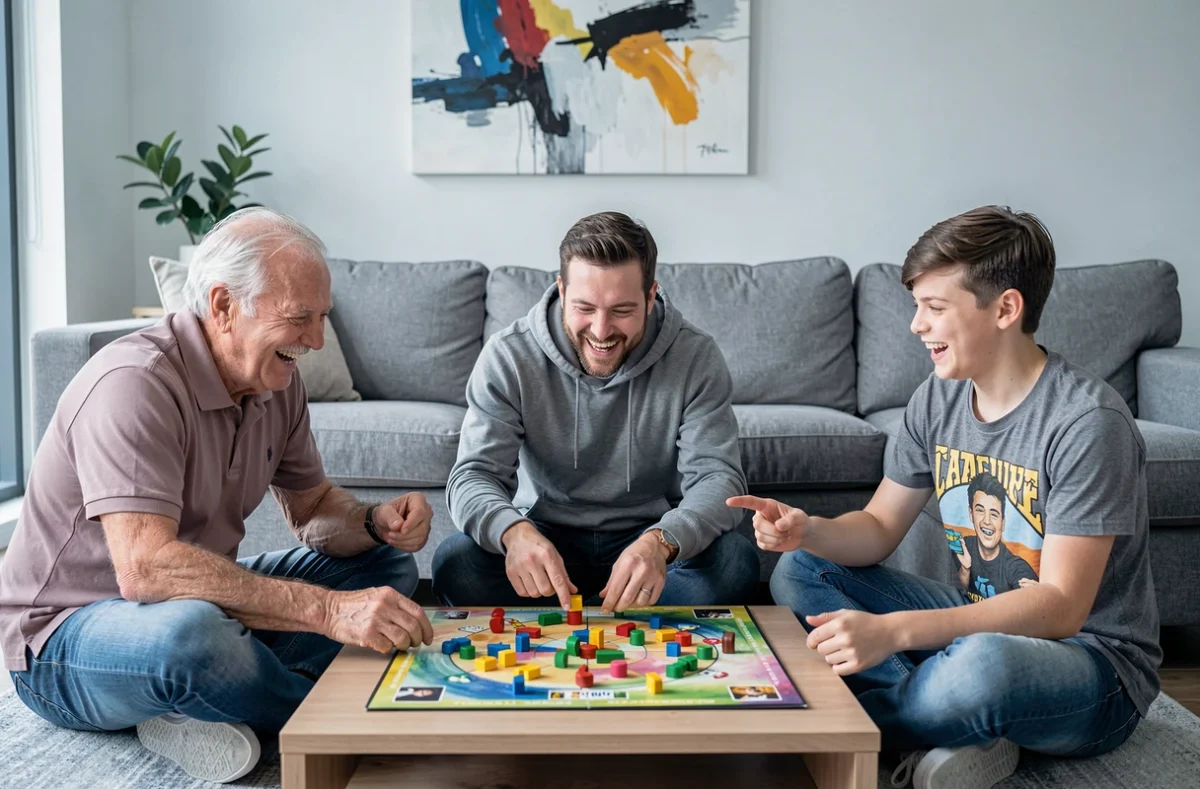
Intergenerational games work best as a regular habit rather than a one-off event. In Sète, the weekly Tuesday gathering has brought together a stable group of participants who return week after week. In Aynac, an association opened an afternoon event to local residents, with different games for different audiences and an introduction to chess led by a local club.
Regular games turn play into a family ritual rather than an occasional activity. Two factors matter more than the choice of game itself:
- A fixed, short time slot (one hour is enough) makes it easier for participants with less time or stamina to join in.
- Rotating games prevents boredom and lets you alternate between light competitive games and cooperative ones, depending on the group’s energy.
- A suitable space, with a table large enough for everyone and good lighting, makes a real difference for senior players.
The Poissy Mobile Games Library and the Maison de Fer have also hosted an afternoon dedicated to different generations and people with disabilities, with an explicit focus on inclusion. Initiatives like this show that making games accessible also depends on the setting, not just the rules.
Don’t treat games as just a children’s activity
A common pitfall is to always choose games aimed at younger children in the name of accessibility. Adults and seniors quickly lose interest in games that feel too childish. Logic, deduction, and negotiation games with short rules offer an alternative that respects every participant’s intelligence without excluding younger players.
Intergenerational board gaming is less about the title printed on the box than how the game is set up. A complex game with adapted rules creates more connection than a simple game that leaves half the table bored.