
The vacuum inlet remains one of the most underutilized pieces of equipment in a pool’s hydraulic circuit. It constitutes a dedicated suction circuit whose adjustment directly affects cleaning efficiency. Mastering the valve settings, suction flow rate, and choice of vacuum head allows for a clean pool bottom without overloading the pump or prematurely clogging the filter.
Pool vacuum inlet and hydraulic circuit: what simplified diagrams don’t show
In most installations, the vacuum inlet is directly connected to the suction circuit, in parallel with the skimmers and the main drain. The water sucked in by the vacuum inlet passes through the pump’s pre-filter, then through the filter (sand, glass, cartridge) before being returned to the pool.
The distribution of flow plays a crucial role. When all three suction sources (skimmers, main drain, vacuum inlet) are open simultaneously, the flow divides and the suction at the vacuum becomes insufficient. The fine debris stirred up by the vacuum head then goes uncaptured and falls a few meters away.
To concentrate the suction power on the vacuum inlet, one must adjust the valves located upstream of the pump. Understanding the use of the vacuum inlet to clean the pool primarily involves correctly manipulating these valves, a technical gesture that installation manuals rarely detail.
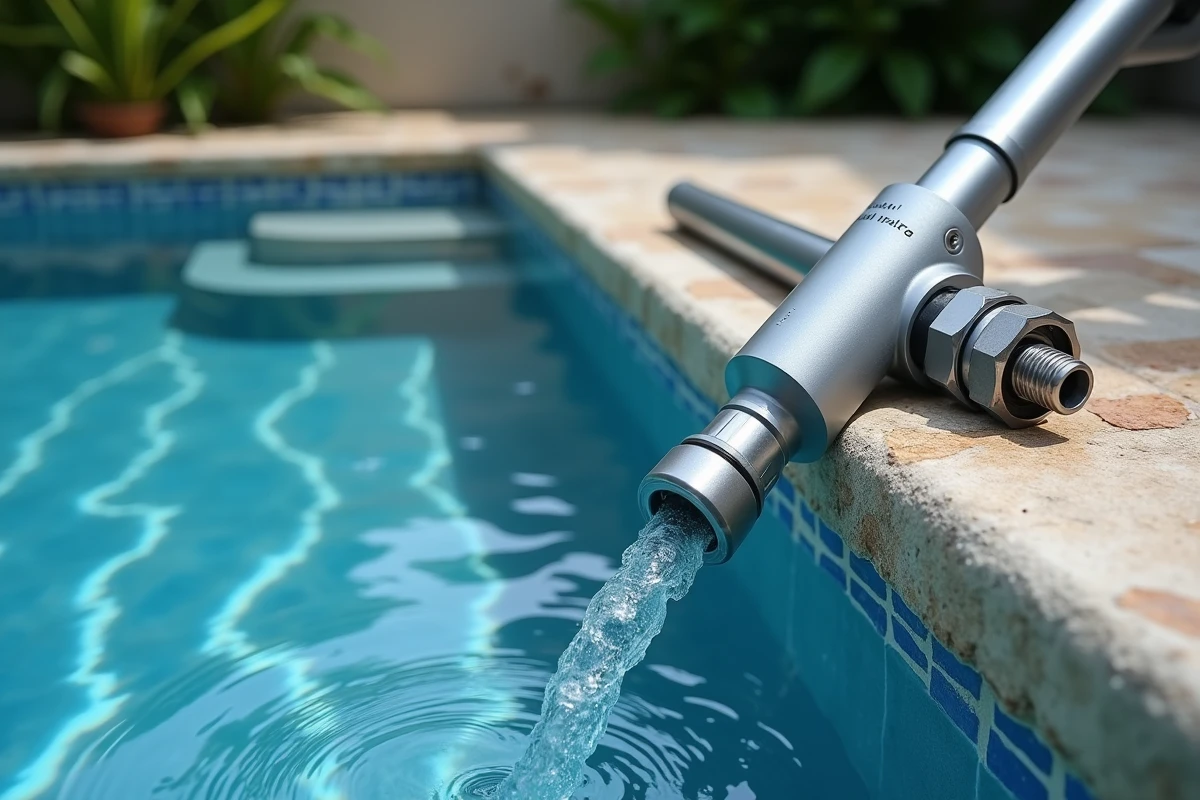
In practice, closing the skimmer valve and the main drain valve during vacuuming forces the entire flow to the vacuum inlet. The filter’s six-way valve remains in the “filtration” position for standard cleaning, or on “waste” if the pool bottom has significant deposits (dead algae after a shock treatment, for example).
In the waste position, the sucked water is discharged without passing through the filter again, which prevents it from becoming saturated. In return, the pool level drops and must be compensated.
Adjusting the suction flow rate: finding the right balance for the pool vacuum
A flow rate that is too strong presses the vacuum head against the bottom and makes movement difficult. A flow rate that is too weak does not capture fine particles. The adjustment is made by partially opening the main drain valve.
The most reliable method is to completely close the skimmers and main drain, then gradually reopen the main drain valve until a strong suction is felt at the vacuum head without it sticking to the liner or surface. This adjustment depends on the pump’s power and the diameter of the pipes, which explains why field reports vary on this point from one pool to another.
Two precautions to keep in mind during this manipulation:
- Never close all suction valves at the same time while the pump is running, as this could cause it to run dry and damage the mechanical seal.
- Completely purge the air from the vacuum hose before connecting it to the vacuum inlet by submerging it section by section until no bubbles rise.
- Check that the pump’s pre-filter is not already clogged before starting the suction, as a full basket reduces the available flow and strains the pump.
Choosing the vacuum head according to the pool surface
Textured surfaces (reinforced PVC with a grainy finish, structured tiles, non-slip liners) have multiplied in recent years. These surfaces retain more fine deposits and biofilms compared to a standard smooth liner.
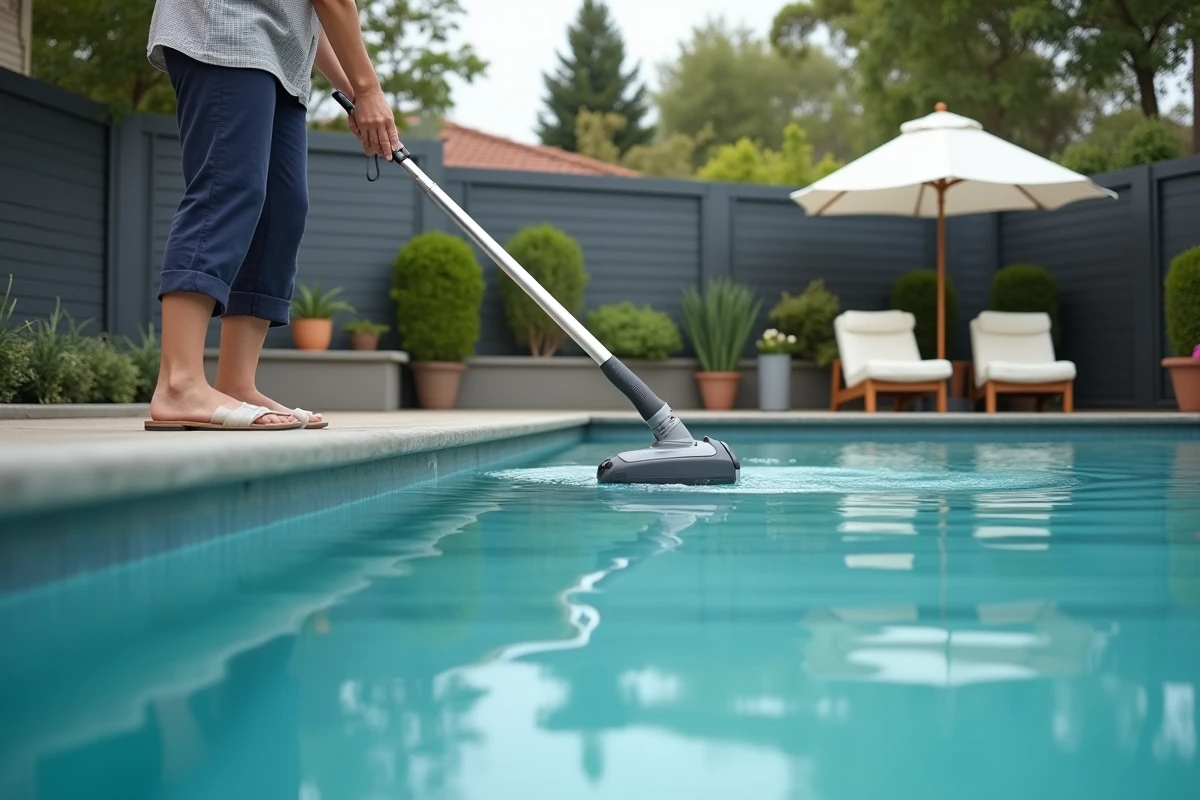
On a textured surface, a vacuum head with long soft bristles dislodges particles better than a model with only wheels, which glides over the roughness without reaching the micro-depressions. The movement must be slower and more deliberate: sweeping a textured area at the same speed as a smooth liner leaves a significant amount of deposits in place.
On a smooth liner or gel-coated polyester, a head with wheels and short brushes is sufficient and facilitates gliding. Adapting the vacuum head to the surface is a parameter often overlooked that visibly changes the final result.
Protecting the pump and filter during vacuuming
Suction through the vacuum inlet sends larger and more concentrated debris to the pump than normal filtration through the skimmers. The risk of clogging the pre-filter basket or the filter media significantly increases, especially after a period of non-use or an algaecide treatment.
The use of skimmer socks or inline pre-filters has become common among pool owners in recent years. Placed in the pre-filter basket or directly on the vacuum hose connection, a filtering sock captures coarse particles before they reach the filter media. This action reduces the frequency of backwashing and extends the lifespan of the sand or glass filter media.
After each vacuuming session:
- Reopen the skimmer and main drain valves to restore normal circulation.
- Check the filter gauge: if the pressure has notably increased, backwashing is necessary before restarting filtration.
- Rinse the pre-filter basket and the filtering sock to prevent captured debris from decomposing and generating phosphates in the circuit.
Vacuum inlet and hydraulic robot: compatibility to check
Some hydraulic robots (suction type) connect directly to the vacuum inlet and use the filtration pump as a source of suction. Not all hydraulic robots are compatible with all vacuum inlets: the diameter of the connection, the minimum flow rate required by the robot, and the pump’s power must match.
A hydraulic robot connected to an undersized vacuum inlet will move slowly and not vacuum properly. Conversely, a flow rate that is too strong can lift a lightweight robot off the bottom and reduce its adherence. The robot’s technical specifications usually indicate an optimal operating flow rate to compare with the actual flow available at the vacuum inlet, with the valves closed.
Autonomous electric robots, which have their own pump and filter, do not use the vacuum inlet at all. The manual vacuum remains complementary even with a robot, especially for hard-to-reach areas (stairs, benches, rounded corners) that robots cover poorly.
The vacuum inlet is not a secondary piece of equipment. When properly adjusted, with the right valves closed and a vacuum head suited to the surface, it ensures a cleaning of the pool bottom that only the manual vacuum can cover as precisely, especially in corners and on steps.